
Responsibility decision guide
Hong Kong roof leakage repair responsibility guide
A ceiling stain in a top-floor unit does not by itself identify who is responsible. Investigate the water-entry source first, then check whether the affected element is a common part, an exclusive-use part or an owner alteration, and review the deed of mutual covenant.
Short answer
Where seepage involves a common roof, external wall or communal pipe, the Owners’ Corporation or co-owners will generally need to deal with the common part under the deed of mutual covenant and the Building Management Ordinance. Where the source is an individual owner’s pipe, exclusive-use part or alteration, that owner may need to act. Final responsibility depends on the investigation findings, the deed and case-specific legal advice.
Editorial record
Published2026-07-28
Updated2026-08-04
Content ownerProficient Waterproofing & Engineering Limited
Reviewed byProficient Waterproofing technical team
This page provides engineering-investigation and project-coordination information, not legal advice. Repair responsibility and cost allocation must be checked against the deed of mutual covenant, the actual source and applicable law.

First responsibility check
Initial direction for three common situations
| Situation to confirm | General direction | Documents or evidence to verify |
|---|---|---|
| Common roof, external wall or communal pipe | The OC, co-owners or authorised manager arranges investigation and any required repair | Deed, common-parts plans, seepage investigation, OC resolution and works scope |
| Exclusive-use part, private pipe or owner alteration | The relevant owner arranges investigation and repair and coordinates with the affected unit | Title or deed boundaries, pipe or alteration location, test results and photographs |
| Source not established or potentially crosses several locations | Stakeholders jointly arrange a professional investigation instead of allocating responsibility from the stain location alone | Rain records, seepage timeline, test method, adjacent locations and repair history |
This table is only an initial classification. The Buildings Department also recommends appointing building professionals or legal advisers where needed and requiring the responsible person under the deed to act.
01 Source before liability
Identify the water-entry source before discussing responsibility
A ceiling stain shows where water became visible, not necessarily where it entered. Rainwater may enter through a roof, podium, external wall, window or junction, while supply or drainage pipes can create a different source.
The investigation should record timing, weather, affected areas, upper and adjacent locations, pipes, outlets, cracks and earlier repairs, then select a test method suitable for the site.
- 01Seepage timeline and relationship to rain
- 02Roof, external wall, pipes and adjacent locations
- 03Test method, limitations and findings
- 04Earlier repairs and building-management records
02 DMC & common parts
Use the deed to distinguish common and exclusive-use parts
The Home Affairs Department explains that the deed of mutual covenant defines common parts, exclusive-use parts, owners’ rights and duties, and maintenance-cost arrangements. Under section 18 of the Building Management Ordinance, an Owners’ Corporation has a duty to maintain common parts in a state of good and serviceable repair.
Even when a roof sits above a top-floor unit, location alone does not make that owner responsible. Check the deed, ownership boundary, exclusive-use rights and actual seepage source.
03 Coordination sequence
A practical sequence for the OC, manager and owners
After a complaint, establish one set of photographs, dates and location records, arrange access and investigation, then use the findings to define the repair scope, responsible party, quotation comparison and works monitoring.
For a common roof or external wall, the manager should retain the investigation, meeting decision, contractor scope, construction photographs, inspection and handover records together.
- 01Acknowledge and record the complaint
- 02Arrange access to units and common areas
- 03Define scope using the deed and investigation
- 04Retain resolutions, quotations, works and handover records
04 Engineering boundary
What a contractor can address—and what it cannot replace
A waterproofing contractor can survey visible conditions, organise the works scope and propose construction and record-keeping arrangements. Independent liability findings, professional reports, structural advice or legal interpretation require the appropriate building professional, surveyor or legal adviser.
The quotation should state assumptions, limitations and exclusions so an unresolved responsibility question is not presented as a construction commitment.
Project evidence
Related project records
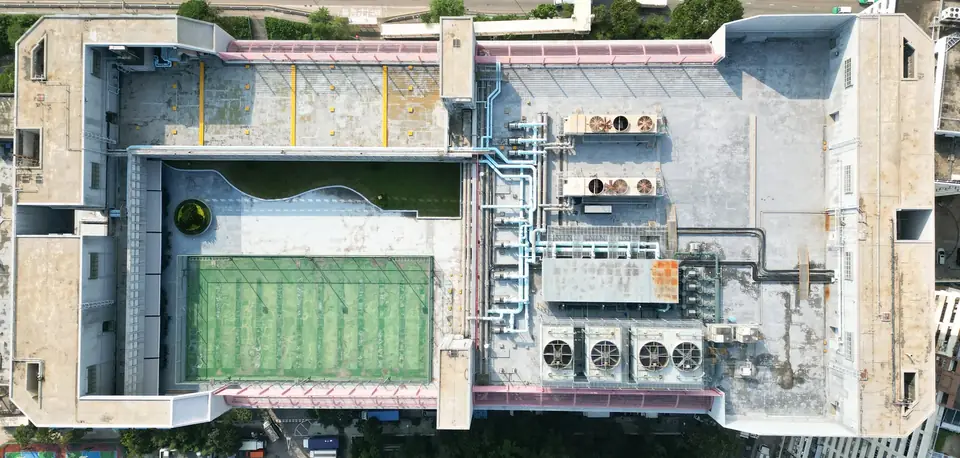
Tuen Mun
YKK Building Phase 3, No. 7 San Ping Circuit
Commercial-building roof and building-services waterproofing
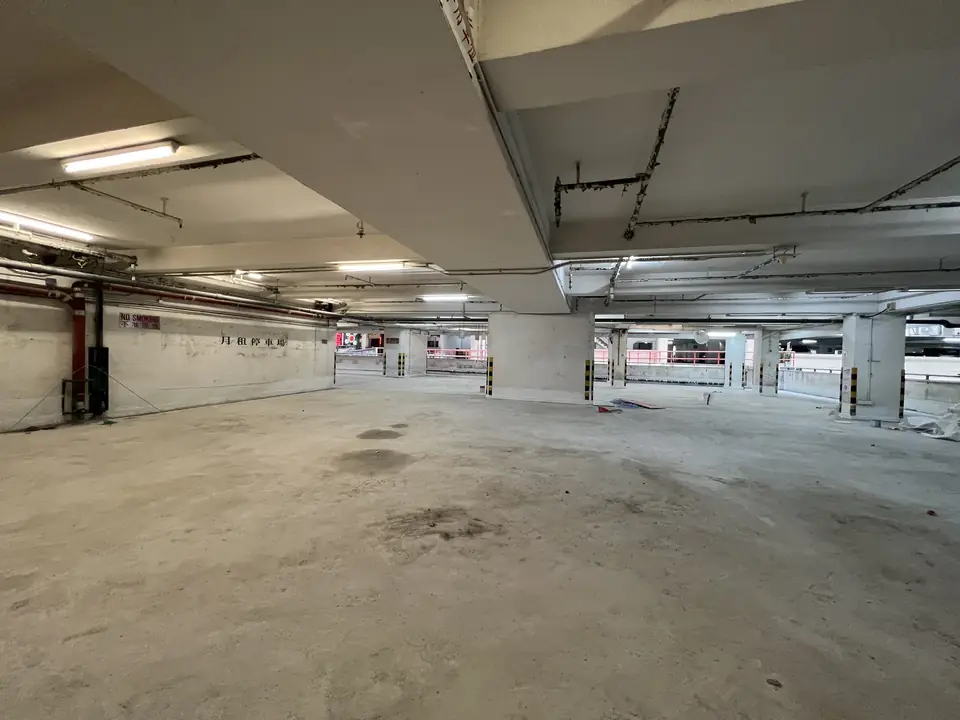
Fortress Hill
Lee Man Commercial Centre
Commercial-building podium and car-park waterproofing repairs
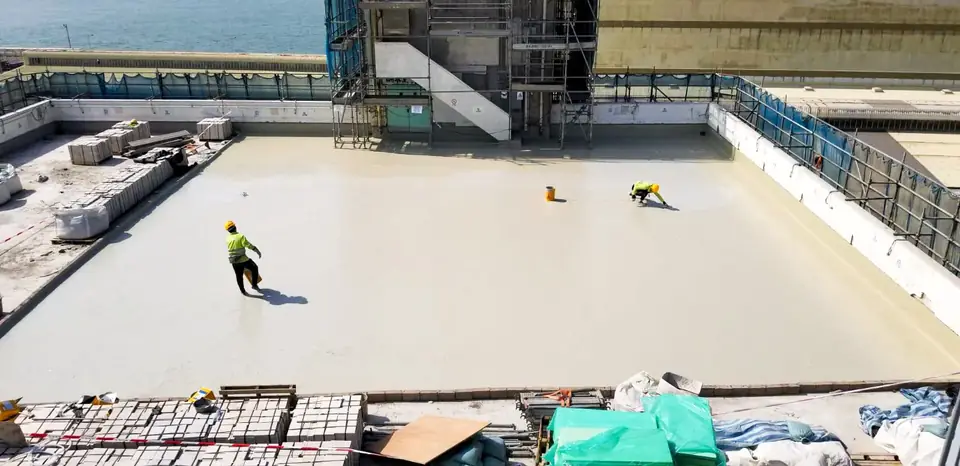
Tsing Yi
Shell Oil Depot, Tsing Yi
Industrial-facility waterproofing

Hong Kong
Wadee Garden Blocks 21 and 22
Residential-estate roof waterproofing

Kwai Chung
On Yam Shopping Centre, Kwai Chung
Estate-podium and roof waterproofing
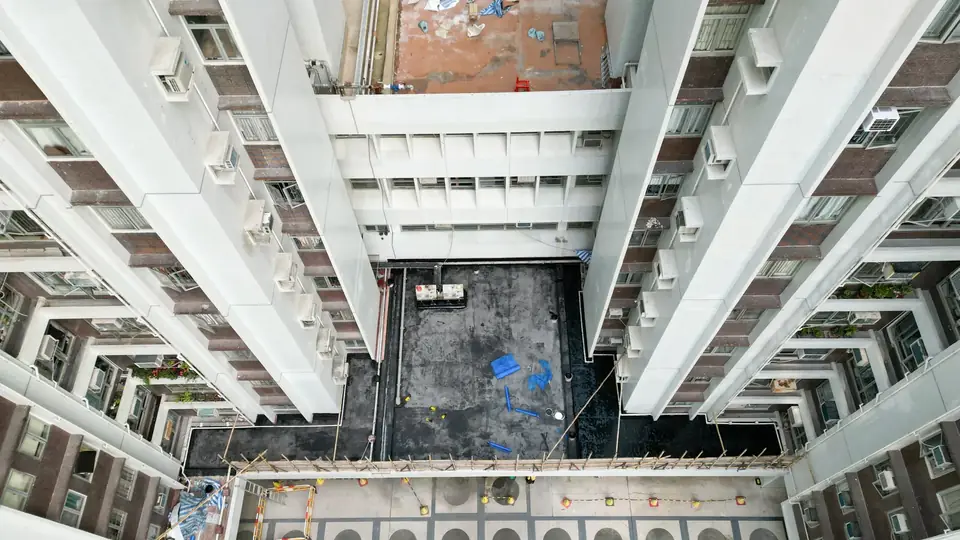
Hong Kong East
Taikoo Shing Centre
Residential-estate podium and pool-surround waterproofing
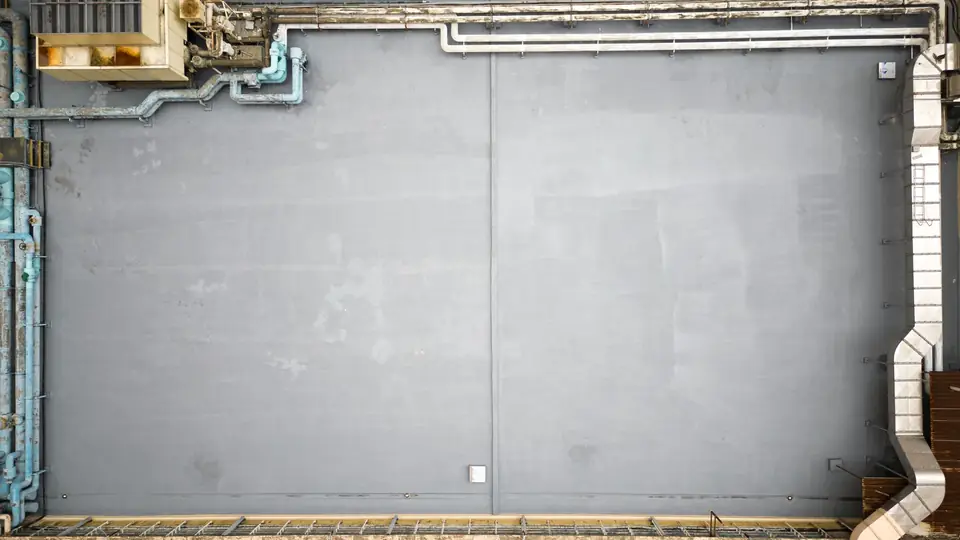
Kowloon Bay
Amoy Gardens, Kowloon Bay
Large residential-estate waterproofing
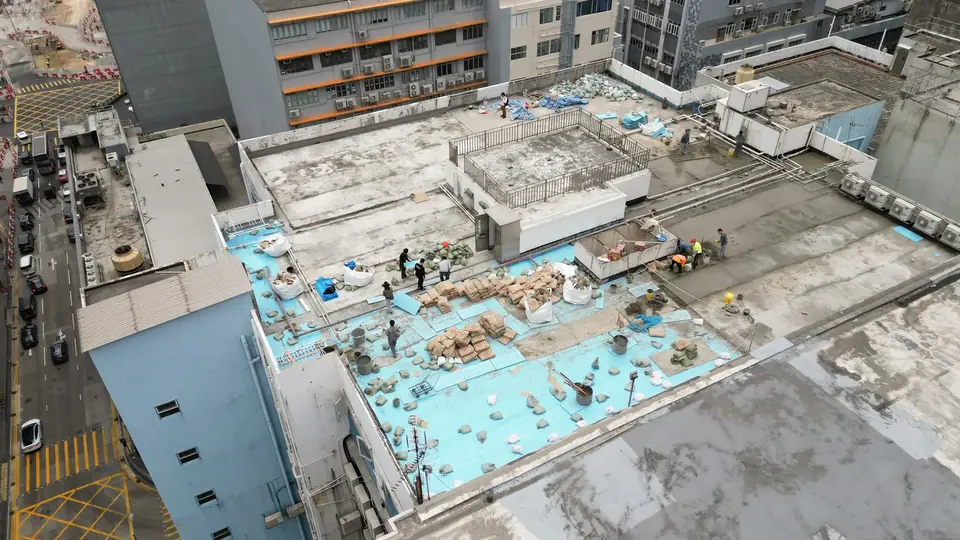
Kowloon
Hung Wan Industrial Building, Kwun Tong
Industrial-building roof-waterproofing refurbishment
FAQ
Questions to settle before the works
Is the OC always responsible for leakage in a top-floor ceiling?+
No. Investigate the source and check the deed. A common roof, external wall or communal pipe is generally dealt with by the OC or co-owners under the deed, while a private pipe, exclusive-use part or alteration may fall to the relevant owner.
Can the water-entry source be identified from the stain location alone?+
No. Water can travel through structures, cracks and junctions, so the visible stain may not be the entry point. Use a site survey, timeline and suitable testing.
Will the Joint Office deal with rainwater entering through a roof?+
Buildings Department guidance says rain penetration through roofs, podiums, balconies, external walls or windows will normally not constitute a public-health nuisance for prosecution under Cap. 132. The Joint Office may advise the OC to inspect and repair and may refer building-safety concerns where appropriate.
How should a building without an OC proceed?+
Co-owners remain responsible for managing and repairing common parts under the deed and ownership arrangements. A deed manager or authorised person may coordinate the work; legal advice should be obtained for disputes about liability or cost allocation.
Which responsibility records should be kept before work starts?+
Keep the relevant deed clauses, investigation findings, photographs, location plan, stakeholder notices, meeting decisions, quotation scope, and testing and handover requirements.
Source record
Sources and verification links
- 01Buildings Department: water seepage problems
Seepage causes, owner and occupant responsibilities, management or OC coordination and professional advice.
- 02Buildings Department: water seepage FAQs
Rain penetration, the Joint Office boundary and OC inspection of roofs and external walls.
- 03Home Affairs Department: introduction to Owners’ Corporations
The OC’s statutory duty to manage and maintain common parts and the role of the deed.
- 04Joint Office: rainwater and water-supply-pipe leakage
The Joint Office’s handling boundary for rainwater and supply-pipe leakage.
Project enquiry
Need to organise the likely source and investigation scope first?
Send photographs of the roof, ceiling stains, outlets and adjacent locations together with known repair records. The engineering team can organise the areas to inspect, but initial photographs do not replace a legal determination of responsibility.